As seen on

Curious what a treatment at VIVA looks like? Watch our treatment demonstration below with the full treatment process with before and afters.

Dr Rupert Critchley MD · Founder, VIVA Skin Clinics · JCCP member
Stretch marks are incredibly common, affecting most people at some point. They’re completely harmless, but many people would like them to be less noticeable. This guide explains what stretch marks are, what causes them, whether they go away, whether you can get rid of stretch marks, which treatments help, whether oils and creams work, how to relieve itchy stretch marks and how to prevent new ones.
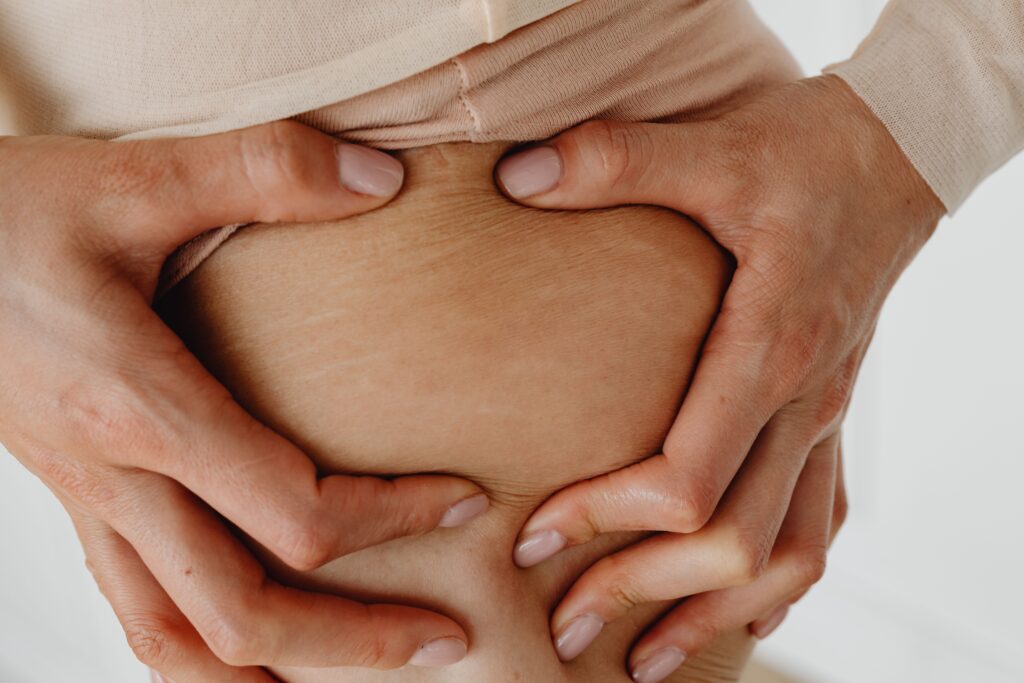
Stretch marks (striae) are narrow streaks or lines that form when the skin stretches or shrinks quickly. The rapid change tears the collagen and elastin fibres in the dermis, the deeper layer of skin that gives it strength and stretch. As the skin heals, it leaves a type of scar.
Stretch marks change over time:
They’re most common on the stomach, breasts, hips, thighs, bottom, upper arms and lower back.
If stretch marks appear suddenly without an obvious cause, or cover large areas, speak to your GP.
Stretch marks rarely disappear completely on their own, but they do usually fade. Over months to years, red or purple stretch marks typically become lighter, flatter and less noticeable as they mature into silvery-white lines. Treatment can speed up this improvement and help with texture.
Because stretch marks are a form of scarring, no treatment can remove them completely. But you can often get rid of much of their visibility. Their colour, texture and depth can be improved, so they’re far less noticeable. Two things make the biggest difference:
Medical microneedling with SkinPen creates tiny, controlled channels in the skin. This triggers the skin’s natural healing response, encouraging new collagen and elastin, which can soften the texture and depth of stretch marks over a course of treatments. It works on both newer and older stretch marks, and it’s suitable for a wide range of skin tones. At VIVA, we use SkinPen on the body as well as the face. It can also be combined with exosomes to support healing.
Prescription retinoid creams, such as tretinoin, may help early stretch marks look less noticeable. They aren’t suitable in pregnancy or when breastfeeding, and need to be prescribed.
Some clinics use lasers to target the redness of new stretch marks or the texture of older ones. Your practitioner can explain whether this might suit you.
Chemical peels can help with skin tone and texture, but they work on the surface, so they have a limited effect on stretch marks on their own.
Many people try oils, butters and creams, such as cocoa butter, shea butter, almond oil or bio oil. These keep skin soft and supple and may reduce itching, but there’s limited evidence that they remove or prevent stretch marks. Massaging them in may help a little with how the skin feels. Ingredients with more evidence include hyaluronic acid and centella asiatica, though results are modest.
New stretch marks often itch as the skin stretches. To relieve them:
Up to eight in ten pregnant women develop stretch marks. They usually appear on the stomach, breasts, hips and thighs as the skin stretches. Most fade significantly in the months after birth.
In-clinic treatments such as microneedling and retinoid creams aren’t recommended during pregnancy or breastfeeding. Many people start treatment once they’ve finished breastfeeding, when the stretch marks are often still red and respond well.
Rapid weight changes are a common cause. Losing weight won’t remove stretch marks, but it won’t usually make them worse. Losing or gaining weight gradually gives the skin more time to adapt and can reduce new stretch marks. If weight loss has also left loose skin on the neck, see how to get rid of turkey neck.
You can’t always prevent stretch marks, especially if they run in your family or you’re pregnant. But these may help:
Most people need a course of three to six sessions, spaced around four to six weeks apart. Collagen builds slowly, so improvements continue for several months after the course.
Expect redness and mild swelling for a day or two, like a light sunburn, with some dryness afterwards. Less commonly, microneedling can cause infection or pigmentation changes. Following aftercare and protecting the area from the sun reduces these risks.
At VIVA, SkinPen microneedling costs £300 per session, £750 for a course of three or £1,500 for six. See our price list. Payment plans and 0% interest finance are available, and VIVA CLUB members get 10% off through the VIVA app.
We offer SkinPen microneedling at our clinics in Fitzrovia and Chelsea in London, Tunbridge Wells in Kent and Weybridge in Surrey. All treatments are carried out by nurses and doctors, and consultations are free.
Every treatment at VIVA is carried out by qualified nurses and doctors, so you’re in safe, experienced hands from consultation to aftercare.
Consultations are always free, giving you the chance to talk through your goals, ask questions and get an honest recommendation before you commit. Payment plans are also available across our treatments with Clearpay and Klarna.
You’ll find us at three clinics, with a fourth opening in Surrey this November:
Download the VIVA app to join VIVA CLUB and get 10% off all treatments, plus easy booking and appointment management.
We offer new client bookings and exciting offers monthly, so book soon to secure your appointment. Our consulations are free and we offer flexible finance.
Book online here or through the VIVA app. For any questions, call us on 02037 332199 (Mon–Fri 10am–7pm, Sat 10am–4pm).
While your dedicated practitioner will always be there to answer every last one of your questions in person, this section is here to give you a bit of a head start on some of our most common queries.
Narrow streaks that form when skin stretches or shrinks quickly, damaging the collagen and elastin underneath.
No treatment removes them completely, but their colour, texture and depth can often be improved so they're much less noticeable.
They rarely disappear completely, but they usually fade from red or purple to lighter lines over time.
Medical microneedling is one of the most effective options for improving texture. The right choice depends on the age and colour of your stretch marks.
They keep skin supple and may ease itching, but there's limited evidence they remove stretch marks.
At VIVA, SkinPen microneedling costs £300 per session, with course prices available.
We have two convenient locations in London and one in Kent located in beautiful Tunbridge Wells. Click below to find your nearest VIVA!
Get our special offers, see before and afters and learn more about what makes VIVA Skin clinics the Uk’s leading cosmetic clinic.